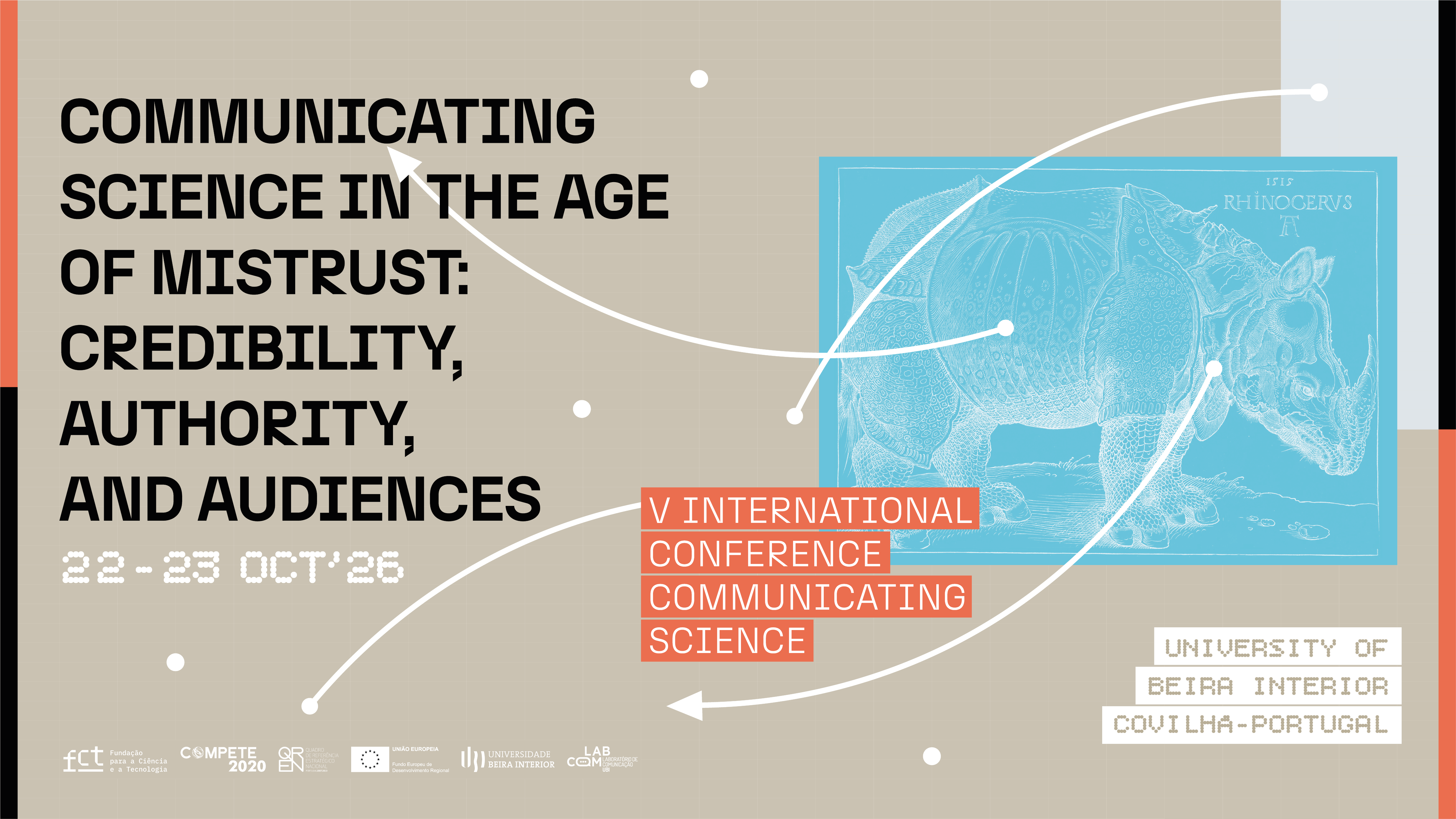
V Conference Communicating Science in the Age of Mistrust: Credibility, Authority, and Audiences
October 22-23 2026
The 5th Communicating Science Conference reflects on the crisis of trust in the field of science, and the role of literacy and public engagement in relation to the credibility and authority of experts. The age of distrust results from the paradox that science has never produced so much knowledge and yet trust in scientific institutions has never been so fragile. Vaccine hesitancy, climate change denial, health misinformation amplified by digital platforms, the proliferation of synthetic content generated by artificial intelligence, various forms of denialism, and the erosion of experts’ authority are relatively recent phenomena that pose unprecedented challenges to science communicators, whether in journalistic, institutional, educational, or outreach contexts.
Aimed at researchers, scientists, science communicators, and journalists, the fifth edition of Communicating Science maintains an interdisciplinary and comparative perspective, welcoming contributions from communication sciences, sociology of science, science journalism, digital media, health communication, media literacy, and science education. Proposals that reflect on science communication by articulating the Portuguese-speaking context with international trends are especially welcome.
Communicating Science in the Age of Distrust invites researchers, journalists, educators, and science communication professionals to question the current moment of epistemic crisis from multiple perspectives. How are scientific reputations built and destroyed in the public sphere? What communicative practices can restore the credibility of science? How do scientists navigate media exposure in polarized environments? What is the role of science literacy and public understanding in restoring trust? Can the media, platforms, museums, and schools improve the mediation between science and the public?
The following are topics of interest for this conference:
• Research Ethics
• Publication Integrity
• Communication and Dissemination
• Public Understanding of Science
• Misinformation
• Scientific and Media Literacy
• Data Design and Visualization
• Science Policy
• Slow Science
• R&D Evaluation and Funding
• Information and Knowledge Management
• Epistemological Worldview
• Public and Political Deliberation
Echoing these thematic lines, the fifth edition unfolds through six main thematic panels:
Trust, Credibility, and Scientific Authority: What erodes trust in science? What communication strategies restore it? Institutional, individual, and media factors.
Digital Platforms and Scientific Misinformation: Algorithmic amplification of pseudoscience, AI-generated health misinformation, conspiracy theories, synthetic media, and the problem of platform authenticity and accountability.
Science Journalism: Pressures in newsrooms, precariousness of science editorial departments, and new models of scientific coverage for digital audiences.
Health Communication and Climate Change: Lessons from COVID-19 and climate denial: communicating risk, uncertainty, and consensus under pressure.
Slow Science and the Future of Science Communication: Which models of scientific communication are compatible with a slow logic? How to communicate uncertainty, process, and the long time frame of science in a public sphere dominated by instantaneity? Slow formats in a fast sphere: podcasts, books, documentaries, and long-form journalism.
Science Education and Public Engagement: Citizen science, science museums, schools, and the role of informal learning contexts in scientific literacy.
The 5th International Conference on Communicating Science invites the submission of proposals (abstracts) to be presented in the thematic sessions of the event. The conference will take place at the Faculty of Arts and Letters of the University of Beira Interior, in a mixed format (in-person and hybrid), and will be broadcast live on the LabCom YouTube channel.
Abstracts should be between 1500 and 2500 characters. Abstracts should include a title, introduction, subject matter, methodology, analysis, and expected results. They should also indicate the author and co-authors, affiliated institution, and contact email.
Abstract submission: until July 20th
Notification of acceptance: until August 10th
Deadline for registration of authors with accepted proposals:
• September 5th (early bird)
• September 14th (late registration)
Deadline for registration of attendees:
• October 22nd (free of charge, through a link available soon)
Presentation of Communications: October 22nd and 23rd
Submission of full paper: October 30th
Online
– students: €25 (early bird); €50 (late registration)
– researchers: €50 (early bird); €100 (late registration)
In-person
– students: €50 (early bird); €100 (late registration)
– researchers: €100 (early bird); €150 (late registration)
Full fee waiver for official members of LabCom UBI
All abstracts must be submitted via Google Forms (available soon).
Template available here:
Abstract V International Conference
Questions and other inquiries can be sent to the following address:
comunicarciencia@labcom.ubi.pt
Abstracts will be subject to a double-blind peer review process.
Portuguese, English, Spanish and French.
• Book of abstracts with the conference program and ISBN
• A selected set of papers will be published in book form (not proceedings), admitting as Working languages: Portuguese and English. This volume will have a paperback edition and an open-access electronic edition, optimized for search engines, to maximize dissemination.
Anabela Gradim (anabela.gradim@labcom.ubi.pt)
Catarina Moura (cmoura@ubi.pt)
Danielly Bezerra (daniellybdossantos@gmail.com)
João Pedro Baptista
Lourenço Silva Ferreira (glourencosilvaferreira@gmail.com)
Ada Cristina Machado Silveira, Univ. Federal de Santa Maria/BR
Amélia Augusto, Universidade da Beira Interior
Ana Carolina Monari, Univ. Estadual de Campinas/BR
Ana Catarina Pereira, Universidade da Beira Interior
Ana Leonor Santos, Universidade da Beira Interior
Ana Paula Duarte, Universidade da Beira Interior
Anabela Carvalho, Universidade do Minho
Anabela Gradim, Universidade da Beira Interior
Anabela Oliveira, Universidade de Trás-os-Montes e Alto Douro
André Azevedo da Fonseca, Univ. Estadual de Londrina/BR
André Barata, Universidade da Beira Interior
Bernardo Gómez Calderón, Universidad de Málaga/ES
Branco Di Fatima, Universidade da Beira Interior
Bruna Távora, Universidade de Münster/DE
Carla Cerqueira, Universidade Lusófona
Carlos Camponez, Universidade de Coimbra
Catarina Burnay, Universidade Católica Portuguesa
Catarina Moura, Universidade da Beira Interior
Catarina Rodrigues, Universidade dos Açores
Concha Pérez-Curiel, Universidad de Sevilha
Cristina Marques Gomes, Univ. Federal de Santa Maria/BR
Enric Saperas, Universidad Rey Juan Carlos
Fábio Ribeiro, Universidade de Trás-os-Montes e Alto Douro
Fabrizio Macagno, Universidade Nova de Lisboa
Francisco Javier Paniagua Rojano, Universidad de Málaga/ES
Gil Baptista Ferreira, Instituto Politécnico de Coimbra
Gisela Gonçalves, Universidade da Beira Interior
Gustavo Cardoso, ISCTE
Heitor Costa Lima da Rocha, Univ. Federal de Pernambuco
Helena Sousa, Universidade do Minho
Inês Amaral, Universidade de Coimbra
Irene de Araújo Machado, Univ. de São Paulo/BR
Isaltina Mello Gomes, Univ. Federal de Pernambuco/BR
Ivone Ferreira, Universidade Nova de Lisboa
João Canavilhas, Universidade da Beira Interior
João Correia, Universidade da Beira Interior
Joaquim Paulo Serra, Universidade da Beira Interior
José Ferreira Gomes, Universidade do Porto
José Manuel Azevedo, Universidade do Porto
José Manuel Gomes Pinto, Universidade Lusófona
Juan José Igartua, Universidad de Salamanca/ES
Lucas de Vasconcelos Teixeira, Univ. Federal do Rio de Janeiro/BR
Marcos Palácios, Univ. Federal da Bahia/BR
Maria da Luz Correia, Universidade dos Açores
Maria Manuel Borges, Universidade de Coimbra
Mariana Guenther Soares, Univ. de Pernambuco/BR
Miriam Rodríguez Pallares, Universidad Complutense de Madrid/ES
Moises de Lemos Martins, Universidade Lusófona
Pedro Pinto de Oliveira, Univ. Federal de Mato Grosso/BR
Raquel Recuero, Univ. Federal de Pelotas/Univ. Federal do Rio Grande do Sul-BR
Raul Ramalho, Univ. Federal de Rio Grande do Norte/BR
Ricardo Morais, Universidade do Porto
Samuel Mateus, Universidade da Madeira
Sílvia Socorro, Universidade da Beira Interior
Sonia de Sá, Universidade da Beira Interior
Vasco Ribeiro, da Universidade do Porto
General / Information
comunicarciencia@labcom.ubi.pt
Address
Universidade da Beira Interior
LabCom — Comunicação e Artes
Avenida Marquês d’Ávila e Bolama
6201-001 Covilhã, Portugal
Secretary of the Faculty of Arts and Letters
Mércia Pires
+351 275242023 / ext. 1201